
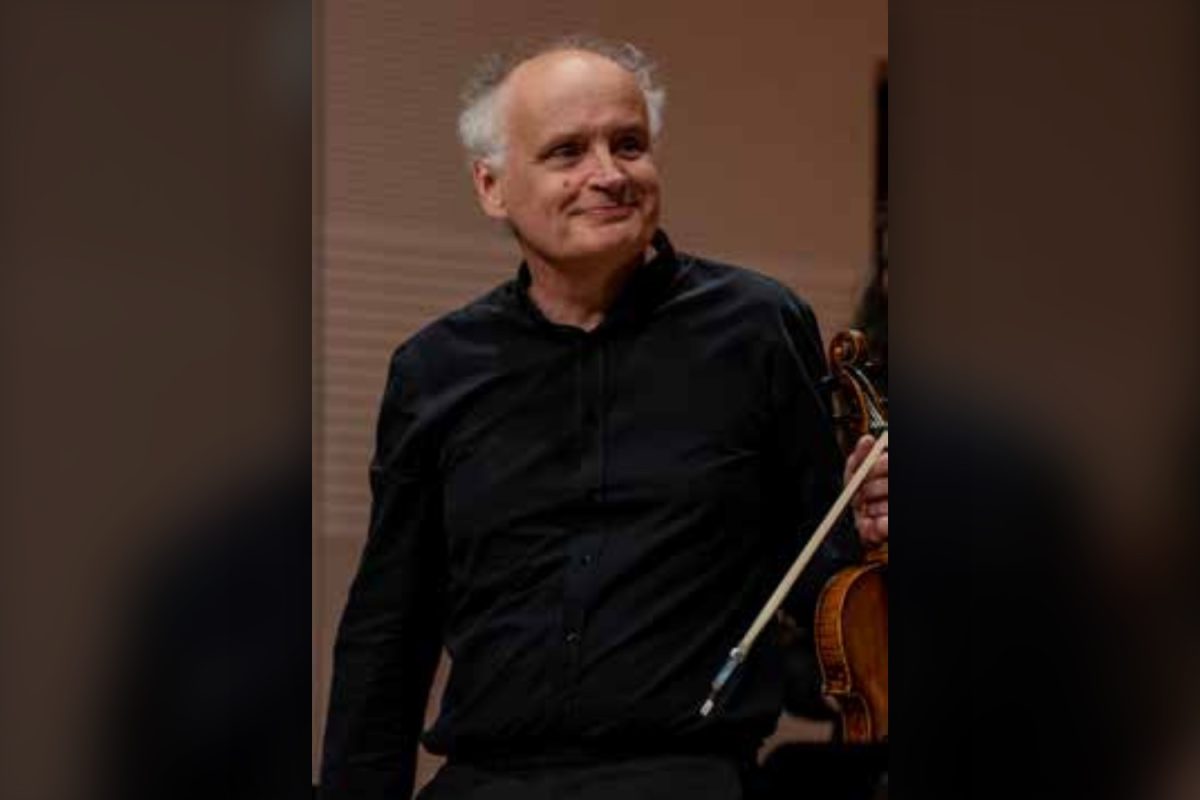
“We do everything we can to make what we do as interesting as possible, both for the audience and for ourselves”
“What we are proud of is the good atmosphere and the friendship between the members, which has been there from the very beginning. Fortunately this has not changed, and the mood is still excellent today,” says violinist János Pilz, concertmaster of the Budapest Strings Chamber Orchestra, whom we asked, among other things, about being a chamber orchestra concertmaster and about his favourite piece for chamber orchestra.
The Budapest Strings is no stranger to music lovers. Could you say a few words about the ensemble?
J. P.: The “Strings” is a chamber orchestra that has been active for nearly five decades, characterised both by preserving good traditions and by constant renewal. The young founders began playing together at the Liszt Academy in 1977. Some of them still play in the orchestra, and Károly Botvay, who was invited to be artistic director at the founding, also continues to follow the life of the orchestra. Last year, on 28 December, we celebrated his 92nd birthday with a festive concert at the Liszt Academy. We hope there will be many more such occasions! What we are proud of is the good atmosphere and the friendship between the members, which has been there from the very beginning. Fortunately this has not changed, and the mood is still excellent today. It is important to have this harmony not only at concerts but also in everyday life, at rehearsals and on tour, because it affects the way we play together.
What is different about playing in a chamber orchestra compared with a full orchestra?
J. P.: The chamber orchestra is perhaps one of the most ideal forms of music-making for string players, since only a few people make up a section. There are 16 or 17 of us at a concert in total, so the individual quality and adaptability of the musicians matter equally. We need to be precise, quick and often improvisatory as well. The psychology of playing together is fascinating: if any section plays a successful phrase, the others take wing, whereas if even the smallest mishap occurs, one the audience may barely notice, that too can spread immediately. We generally play without a conductor. The concertmaster leads the orchestra, which also gives the musicians greater independence.
How does one learn to be a chamber orchestra concertmaster?
J. P.: Leading while playing is not taught in this form; it can only be acquired through practice. I have been the ensemble’s concertmaster since 2012. It was very interesting when I started working here. I had played in symphony orchestras and I am still a member of the Budapest Festival Orchestra, but for 23 years before that I had played almost exclusively in a string quartet, so I had to learn how a chamber ensemble works at rehearsals and in concert. It is no easy task, since I play the first violin part while also having to lead the whole orchestra. We had to learn each other’s musical behaviour. For me, at concerts, that meant learning how much risk can be taken and how to lead so that the music-making is homogeneous yet flexible. The most important lesson of the past years is that even if we are playing Tchaikovsky’s Serenade for Strings for the hundredth time, it will only be truly good if during rehearsals we find, or I find, something in it that had gone unnoticed until then, something that opens new dimensions in the piece.
Do you have a favourite piece for chamber orchestra?
J. P.: One of the most beautiful works we can play is Bartók’s Divertimento. Every performance demands the greatest concentration and inspiration.
How does the orchestra’s season programme come together?
J. P.: Our double bass player, Krisztina Lendvay, comes up with the characteristic pieces of the repertoire, with discerning taste and wonderful ideas, and then several of us decide on the final programme and the soloists to invite. A well-constructed programme is at least as important as the performance itself. We also try to create occasions when we can wander off in a slightly different direction, such as our Zene-Szó (Music and Word) series at the Festetics Palace, where poetry and music meet. Fortunately, many wonderful Hungarian works for string orchestra were written in the decades after Bartók, and we are also glad to perform contemporary pieces. Our two festivals, the early-summer ZeneZug Festival at the Óbudai Társaskör and the Haydn Festival, formerly held in Fertőd and for some years now in Pápa, are also excellent opportunities to go beyond our usual programmes. In Pápa we have already performed a short opera, and at the ZeneZug Festival we have connected with jazz and folk music too. In short, we do everything we can to make what we do as interesting as possible, both for the audience and for ourselves. Routine is important, of course, but only as long as it helps. At some point you must always stop and rediscover what makes it good to play music. I feel that we are strongly united in this as well.
Published in the March 2025 issue of Pesti Műsor. Photo: Bekker Films
 Tickets
